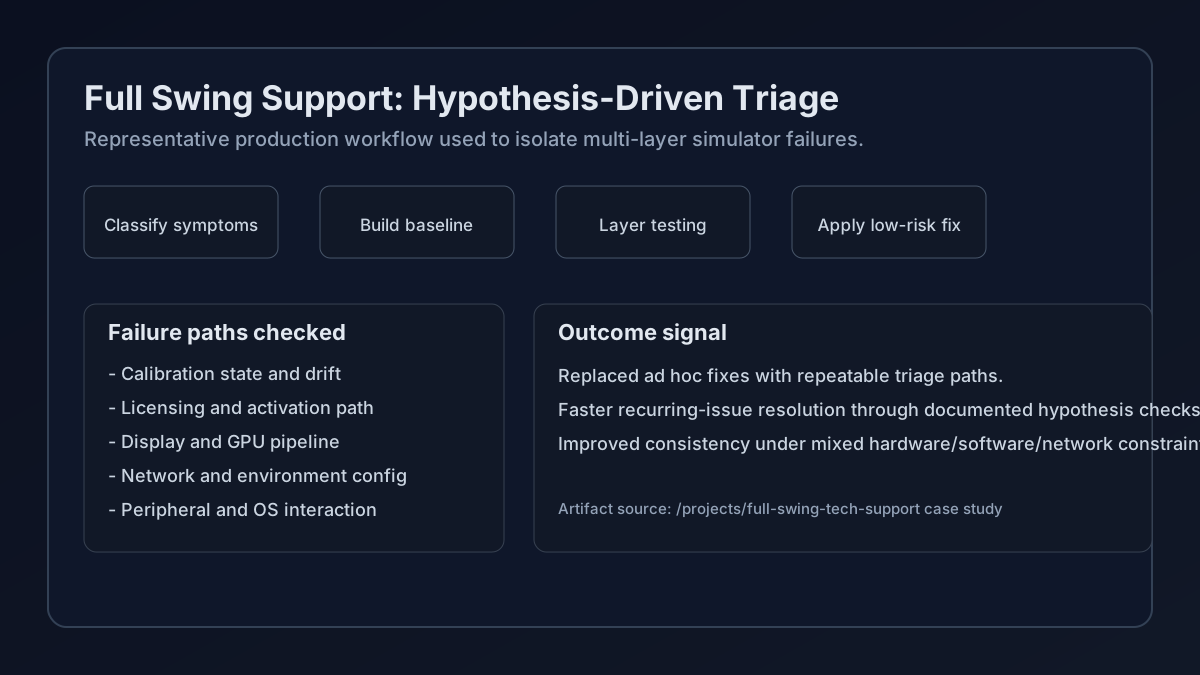
This case study comes from prior work supporting complex simulator systems. It focuses on how multi-layer issues get diagnosed with remote-only access, incomplete logs, and privacy limits on what can be shared.
Problem Context
Incidents were rarely single-point failures. Most escalations involved multiple plausible causes and partial signals, creating a high risk of quick but unstable fixes. The key challenge was identifying root cause with enough confidence to prevent recurrence.
Common Failure Modes
Calibration drift impacting ball/club data accuracy
Licensing and activation failures after environment changes
Display and graphics mismatches across GPU/OS updates
Peripheral and Windows conflicts causing intermittent faults
Diagnostic Workflow
Public triage sketch for multi-layer simulator support, separate from Full Swing vendor artwork.
Below is a simplified linear view of the same idea, useful when you want a quick read of the end-to-end path.
Figure: hypothesis-driven triage (symptom to verified fix)
1. Scope and classify symptoms
Separate user-reported symptoms from underlying system layers (hardware, licensing, network, OS, graphics) to avoid premature root-cause assumptions.
2. Build a reproducible baseline
Capture current environment state and reproduce under controlled conditions to reduce noise and identify which variables are actually causal.
3. Isolate likely failure paths
Use layer-by-layer checks: test one subsystem at a time, log each result, and use those results to narrow the hypothesis list.
4. Apply lowest-risk corrective action
Prioritize reversible fixes first, then progress to deeper remediations only when diagnostics confirm they are necessary.
5. Document and codify pattern
Convert resolved incidents into repeatable troubleshooting paths so similar issues are solved faster and with higher consistency.
Representative Incident Pattern
This walkthrough composites real escalation patterns into one public-safe narrative. Customer-specific details, internal identifiers, and proprietary support tooling are intentionally excluded.
Symptom: FS Core reported that it could not communicate with the required Full Swing API service. At first glance this looked like a network outage because the Core-side communication check failed, but the API endpoint was reachable in a browser on the same machine.
Candidate causes: DNS or ISP issue, firewall or endpoint-security block, expired license/session state, damaged local service state, restricted Windows admin surface, broken WMI namespace/class data, or a vendor-side service issue.
Hypothesis elimination path: First separate basic internet reachability from application-layer communication. Browser access showed the machine could reach the API endpoint, so the next checks moved to local Windows dependencies: service state, Windows management APIs, WMI namespace availability, endpoint policy, and recent update/security changes.
Root cause pattern: The failure pointed past whitelist or port-forwarding checks. WMI namespace errors indicated the Windows management layer was damaged or unavailable, which made the simulator stack behave as if external communication had failed even though basic browser access still worked. Use this path only when evidence points at WMI.
Fix pattern: Run the approved WMI namespace repair batch process, reboot, and re-test Core communication from a clean baseline. In this incident pattern, Core recovered after restart. A changed remote-support ID after reboot was treated as an observed follow-up clue that local Windows management or support-session identity state had been repaired, reset, or reinitialized, not a definitive diagnosis of the exact subsystem that changed.
What changed after: This became a reusable troubleshooting path: when browser access works but Core still reports API communication failure, check WMI/admin health before assuming firewall, DNS, port forwarding, or vendor API outage.
Hypothesis elimination table
A compact view of how plausible layers are ruled out before locking a final cause pattern.
Symptom
Plausible layers
What ruled out alternatives
Final cause pattern
Intermittent misreads after update window
Calibration + GPU/driver + OS mixed state
Controlled baseline and display pipeline checks
Mixed-state config after update + calibration mismatch
Core reports API communication failure while a browser on the same machine can still reach the API endpoint
ISP/DNS, firewall or endpoint block, license/session, local service state, Windows WMI/management layer, vendor API outage
Browser reachability made a simple external-outage theory less likely; WMI namespace errors pointed at the Windows management layer
Damaged or unavailable WMI namespace/management layer; approved WMI namespace repair batch + reboot restored Core communication in this pattern
Tradeoffs
The consistent tradeoff was speed versus reliability. Fast, one-off fixes could close tickets quickly but often increased repeat incidents. A structured, reproducible triage path required more discipline up front, but produced better long-term resolution quality and lower ambiguity on future cases.